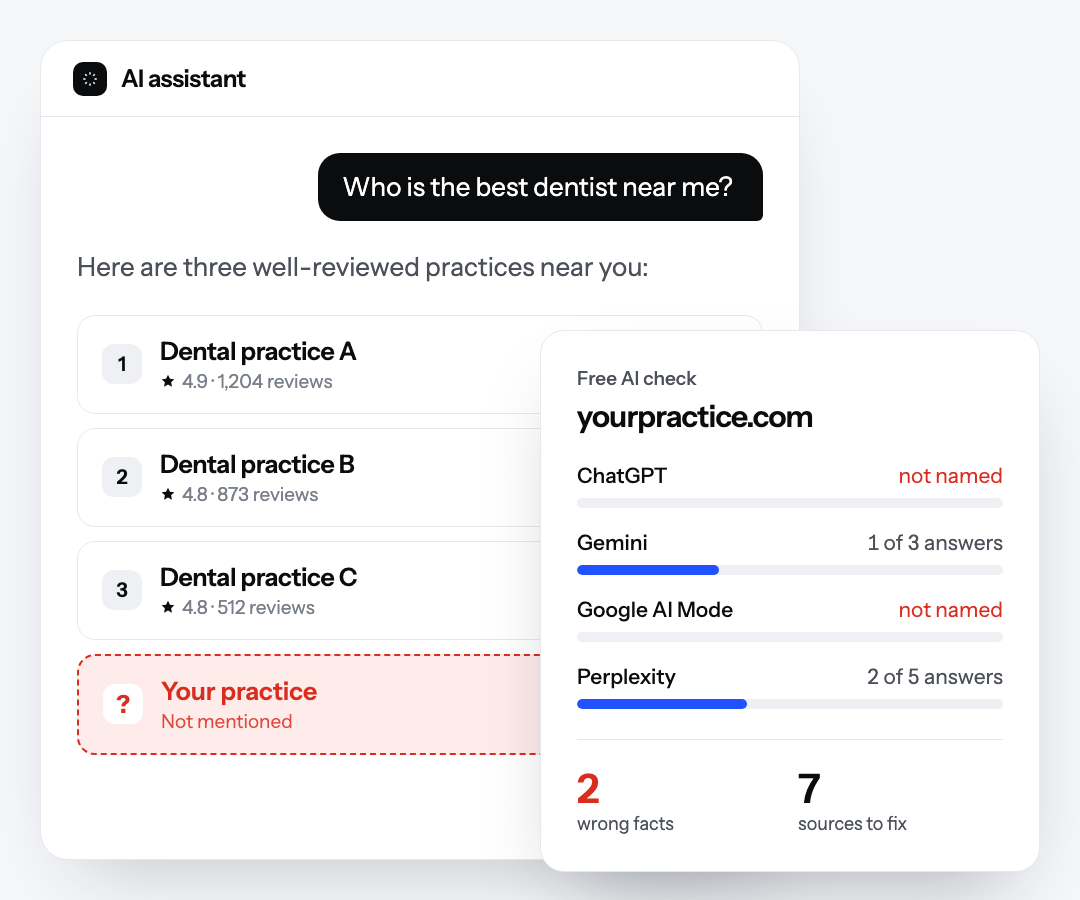
What does an AI visibility audit check?
It checks everything AI assistants read about your business, then asks the assistants directly. Nine blocks, the same for every business:
- AI crawler access, robots.txt and the real server response for OAI-SearchBot, GPTBot, ClaudeBot, PerplexityBot and Google-Extended, including firewall and CDN blocks that robots.txt doesn’t show.
- Readable without JavaScript, whether services, prices and address are in the page’s HTML or only appear after scripts run.
- Business markup, whether your Organization or LocalBusiness structured data is valid and matches your real name and address.
- Name, address, phone, consistency between your site, your Google profile and the directories.
- Google Business Profile, category, services, hours, website link, reviews, duplicates.
- Directories AI cites in your country, e.g. Yelp, Zocdoc or Angi in the US, Checkatrade in the UK, Doctolib in France, Herold in Austria.
- Decision content, service and price pages that answer what customers ask before they call.
- Languages, whether the languages you serve are stated and marked up.
- The AI check, your customers’ questions asked repeatedly in ChatGPT, Gemini and Google AI Mode, plus questions about your business by name.
The deep audit adds what automation can’t do well: page-by-page markup review, a look at who you are as a source (credentials, team, real photos), a teardown of the competitors AI names instead of you, and an implementation plan with hours per item.
Free audit vs deep audit: which do you need?
Start free if you want to know whether there is a problem. Book the deep audit when you want to know exactly what to fix and in which order.
| Free audit | Deep audit | |
|---|---|---|
| How it’s done | Automated | Manual, by an auditor |
| AI runs per question | ChatGPT 3, Gemini 2, AI Mode 1 | ChatGPT 5, Gemini 3, AI Mode 1–2 |
| Questions | Your main category question | Your agreed set, incl. second language or urgent-need variants |
| About your business by name | One question, three engines | Every engine, several facts (address, hours, prices, insurance, staff) |
| Competitors | Who AI names instead, “k of 3” | Teardown of the top competitors: why they get named |
| Output | Report by email, top fixes | Report with an evidence file per finding and a costed plan |
| Time | About a minute; report by email | 5–10 working days |
| Price | $0 | $1,200–1,900 / €890–1,490 |
What AI got wrong in our tests: the question about you by name
The cheapest, most useful test is to ask each engine about your business by name. On 3 October 2026 we did this for 21 businesses in 10 countries and compared every answer with the business’s own website and Google profile (our check; small sample, names anonymized here):
- 16 of 21 businesses had at least one fact that differed, between engines, or between an engine and the business’s own sources.
- In 12 of 21, the business’s own sources disagreed. Website and Google profile showed different hours; a booking system showed different times; a phone number on the site wasn’t the one on the profile. The engine picked one version, and the customer sees whichever it picked.
- 15 clear engine errors, facts matching none of the business’s sources: Google AI Mode 8, Perplexity 4, ChatGPT 3. Examples: a UK roofer’s prices given in dollars, a Zurich practice credited with another practice’s prices, a dental check-up quoted at the old pre-discount price, a plumber given the phone number of a look-alike website.
- Old data keeps circulating. For a US dental practice that had moved, two engines noted that older directories still listed the previous address. The same practice had a second Google profile splitting its reviews.
The clean cases had one thing in common: their website and Google profile said the same thing. That is why the audit traces each wrong answer to its source rather than just reporting it.
This matters because people check. 97% of AI users in BrightLocal’s US survey sometimes check an AI recommendation against real reviews (BrightLocal, 2026). A wrong phone number or hours line loses the call either way.
Find out what AI says about you, free, before you book anything.
How we test AI answers (and why we never show one screenshot)
We ask each question several times on each engine and report how often you were named, as a fraction with a date. In the deep audit, ChatGPT gets five runs per question, Gemini three and Google AI Mode one or two; Google’s map results serve as the baseline.
The reason is in our own data. In our first round, ChatGPT named 90 businesses across eight local questions asked five times each; 44 of them appeared in only one of the five answers. Of the names in a first run, only 21 of 37 belonged to the group ChatGPT named three or more times. Going from three to five runs grew the list from 67 to 90 names. A single run shows a random neighbor about four times in ten. BrightLocal found that asking the same question again repeats only 20–33% of the businesses named (Sep 2026).
We also read the answers as they appear in the ChatGPT and Gemini apps, not through developer APIs: when we compared, the ChatGPT API and app shared only 6 of 24 businesses. And we focus on Google AI Mode rather than AI Overviews for local questions, AI Overviews appeared on only 3 of 29 “category + city” searches in our checks. Full protocol: methodology.
Inside a sample report (demo)
Each report follows the same order: what’s already good, what blocks you, what AI says about you, who AI recommends instead, the prioritized fixes, and what we couldn’t check. Below is an excerpt.
DemoDemo, built from public-data patterns; not a client. Dental practice, US city.
What AI says about you
| Fact | ChatGPT | AI Mode | Perplexity | Your sources |
|---|---|---|---|---|
| Address | Current | Current | Old address (from a directory) | Two Google profiles, old and new |
| Saturday hours | Closed | 9–1 | Closed | Site: 9–1 · Profile: closed |
| Rating shown | Yelp card, 3.8★ | Google, 4.8★ | Mixed | Google 4.8★, Yelp 3.8★ |
| Insurance | “Contact the practice” | Lists one plan | Not found | No insurance page |
Who AI recommends instead, “dentist in [city]”
Practice A: ChatGPT 5 of 5, Gemini 3 of 3 · Practice B: ChatGPT 3 of 5, Gemini 0 of 3 · You: ChatGPT 1 of 5, Gemini 2 of 3, AI Mode 0 of 1.
Prioritized fixes
| Fix | Impact | Effort | Hours | Who |
|---|---|---|---|---|
| Merge the duplicate Google profile at the old address | High | Low | 2 | Us |
| Correct Saturday hours on the website and two directories to match the profile | High | Low | 1 | Us |
| Claim the Yelp page and fix the phone number (US) | High | Low | 1.5 | Us |
| Publish an insurance and payment page | Medium | Medium | 4 | Us + you |
| Add “from” prices to the three most-asked treatment pages | Medium | Medium | 5 | You approve |
| Unblock OAI-SearchBot at the CDN firewall | Medium | Low | 0.5 | Your web host |
What we couldn’t check
Answers for logged-in users or paid plans, a person’s own location or chat history; Copilot, Claude and Grok.
Every finding in a real report links to its evidence: the dated AI answer, the directory page, the server response.
Price, timeline and guarantees
The deep audit costs $1,200–1,900 (€890–1,490), excluding VAT, depending on locations, languages and number of services. It takes 5–10 working days from access to report.
- Credited in full if you start implementation within 30 days, you never pay twice.
- 14-day refund if the audit doesn’t give you at least 10 prioritized actions.
- No accounts change hands. We ask for read access; everything stays in your name.
What we don’t promise: a position in ChatGPT, “getting into AI”, or a visibility percentage. Nobody can promise those when the same question returns a different list each time. For comparison, an Austrian GEO agency lists its audit at €1,500 (ithelps, checked 3 Oct 2026), and self-serve tracking software starts around $29–31 a month (Otterly, BrightLocal; checked 3 Oct 2026), trackers count mentions; they don’t tell you why. See all prices.
What happens after the audit
You choose. Three options, none required:
- Do it yourself. The plan is written for whoever implements it, your developer, marketer or you. We can add two 60-minute calls to walk through it; ask for a quote.
- We implement. Foundation ($3,000–4,500) or Full ($6,500–9,000), fixed price, audit fee credited. For local businesses this is usually our local AI search work: profiles, directories, service pages.
- We measure monthly. Monitor ($149–249/mo) re-runs the same questions so you see change as “named in k of n”.
FAQ
Is there a free AI visibility audit?
Yes. Our free audit runs from your website address, asks ChatGPT, Gemini and Google AI Mode your customers’ question, and emails a full report. The deep audit adds manual checks, more runs, questions about your business by name on every engine, a competitor teardown and a costed plan.
What is a GEO audit?
A GEO audit checks whether AI assistants can find, read and trust the information about your business, and what they currently say about you. For a local business that means your Google profile, the directories AI searches, your reviews and your website, not only page content.
How do I increase the AI visibility of my website?
Fix the sources first: let AI crawlers reach your site, complete your Google profile, keep listings consistent on the directories AI searches, and put services and prices on plain HTML pages. The audit ranks these fixes for your business, with hours attached.
How do you track AI visibility after the audit?
We re-run the same fixed questions, ChatGPT five times, Gemini three times, Google AI Mode once or twice, and report “named in k of n” with a date. The audit itself includes a re-measure at 60 and 90 days if you implement with us; monthly tracking is the Monitor plan.
How much does a GEO audit cost?
Our deep audit costs $1,200–1,900 (€890–1,490), excluding VAT. It is credited in full if you start implementation within 30 days, and refunded within 14 days if it gives you fewer than 10 prioritized actions.