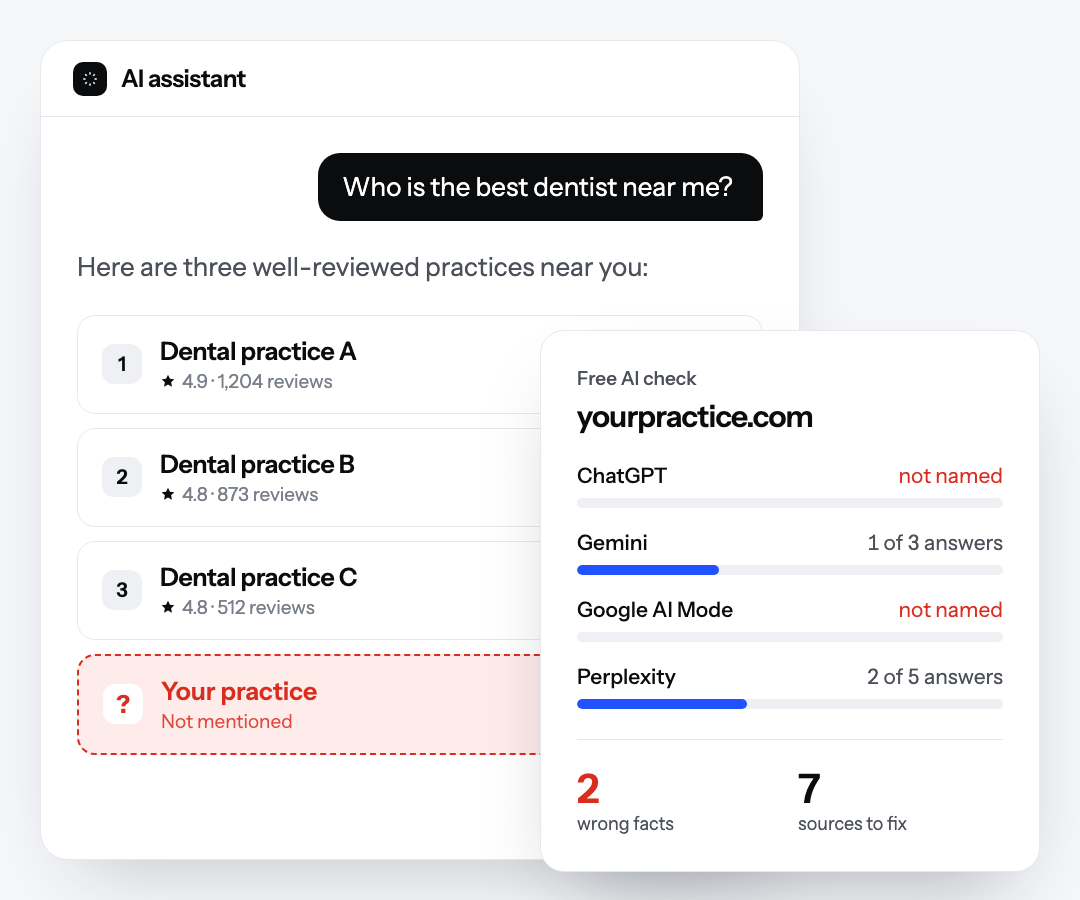
45% of US consumers have used AI tools to find a local business (BrightLocal, 2026), and 97% of them sometimes check the recommendation against real reviews. For movers, that check is the whole game: get named, then pass the check. Both depend on the same facts being identical everywhere: name, licence numbers, address or service area, and reviews that mention real moves. Search ads won’t do it cheaply either. “seo for moving companies” has the highest cost per click of any industry keyword we track, about $122 (our keyword data, 3 Oct 2026).
What ChatGPT and Google AI Mode answer when someone needs movers
For local moves, a stable shortlist; for long distance, a lesson in licensing. On 3 October 2026 we asked “Can you recommend reliable local movers in Austin, TX?” five times in ChatGPT, three times in Gemini and once in Google AI Mode.
- ChatGPT named four movers in all five runs, one more in three, and four others once each. Movers and lawyers were the most consistent lists we measured.
- Google AI Mode named three movers, all from ChatGPT’s core. That kind of agreement was unusual in our checks.
- Gemini was the odd one out: two of its answers named one or two companies, and it added movers nobody else named. 13 movers in total.
Question:“Can you recommend reliable local movers in Austin, TX?”
| Mover | ChatGPT5 runs | Gemini3 runs | Google AI Mode1 run | Google Maps (top results)1 run |
|---|---|---|---|---|
| Mover A | ||||
| Mover B | ||||
| Mover C | ||||
| Mover D | ||||
| Mover H | ||||
| Mover E | ||||
| Mover F | ||||
| Mover G | ||||
| Mover I | ||||
| Mover J | ||||
| Mover K | ||||
| Mover L | ||||
| Mover M |
Long distance: licences, brokers and national van lines
For “Reliable long distance movers from Chicago to Denver”, all three ChatGPT answers explained USDOT registration and the difference between a carrier and a broker, and linked to FMCSA. One answer named only national van lines; the other two named local Chicago movers. Gemini named national networks and brokers, and its list had nothing in common with ChatGPT’s. AI Mode named the big van lines.
City moves: insurance certificates and minimums
For “Best movers in Brooklyn for a small apartment”, Gemini (both answers) and AI Mode brought up building insurance certificates (COI) and minimum hours, which is New York-specific practical detail. ChatGPT focused on prices and hours. If your city has its own moving rules or building requirements, a page that explains them is a page AI can quote.
Where the facts come from
| Source | Seen in our checks |
|---|---|
| moveBuddha | Cited in 8 answers: ChatGPT’s main moving source |
| FMCSA (and the Texas DMV for intrastate) | Cited in 5 answers |
| ConsumerAffairs | Searched in 9 answers |
| Angi, Thumbtack, Expertise.com, Birdeye, LocalMovers, BBB | Searched by ChatGPT |
| Yelp, Reddit | Cited by Google AI Mode; Yelp numbers on many US cards |
| Moving.com | Not seen |
| PagesJaunes, Trustpilot | France: cited and searched for Paris movers |
“Is this mover legit?” What AI checks
We asked ChatGPT, Google AI Mode and Perplexity whether one well-known Austin mover is legit and where it is located (our check, 3 Oct 2026; company anonymized). All three said yes, citing its BBB rating and USDOT registration. Then the details split:
- Two addresses. The Google profile showed one address for a branch; the company’s own location page showed another. ChatGPT gave the first, AI Mode and Perplexity the second.
- Different phone numbers from different branches.
- Three takes on price: “doesn’t publish prices” with a review-site benchmark; “two-hour minimum, no mileage fees”; and a $240–$24,000 range from a third-party listing.
None of it was damaging, but a customer comparing answers sees a company that can’t agree with itself. In Paris, Google AI Mode quoted a mover’s euro prices with a dollar sign. Engines repeat whatever version they find.
Why distance changes who gets recommended
ChatGPT reaches much further from the searcher than Google’s AI does. On average it names 4.1 businesses per answer (BrightLocal, Sep 2026), and the distance within which 90% of recommendations fall differs sharply by engine:
Source: BrightLocal Local AI Visibility Study, 200,085 prompts, US, Sep 2026.
So ChatGPT may name a mover based far away for a long-distance route, while AI Mode stays local. Long-distance movers need route-level content; local movers need a strong map presence. Most movers are service-area businesses, which appear in AI answers slightly less often than storefronts (29.4% against 33.6%, same study). Consistency is how you make up the gap.
The trust layer: licence numbers, broker or carrier, insurance
Give AI and customers the same verifiable facts in the same places. This is not legal advice; check FMCSA’s current rules for interstate moves and your state’s rules for local ones.
| Signal | Where it must appear, identically |
|---|---|
| USDOT number (and MC number if you have operating authority) | Site footer, about page, Google description, Yelp, BBB, quotes and contracts |
| State licence for intrastate moves, where your state issues one | Same places |
| Carrier or broker: a plain statement | Homepage, quote page, Google description |
| Valuation and insurance options in plain language | A dedicated page linked from every quote |
| Address per branch, or a defined service area | Google profile per branch, location pages, directories |
| Company name, exact spelling | Everywhere, including the FMCSA registration |
Customers can look movers up themselves: FMCSA runs a consumer site for interstate moves (Protect Your Move). ChatGPT linked to FMCSA in every long-distance answer. If your registration says one name and your Google profile another, that mismatch is what both of them find.
Route pages AI can quote, instead of city doorway pages
For long-distance work, build one page per route you run often enough to speak about with real numbers:
| Block | What it says |
|---|---|
| Route | “[Origin] to [Destination] movers”, distance |
| Transit window | Typical pickup-to-delivery days for this route |
| What drives the price | Volume, access (stairs, elevators, parking), season, packing, storage |
| Your price range | From your own invoices, dated, with what it includes |
| Proof | Photos of your trucks and crew, two or three reviews that mention this route |
| Licence line | Carrier or broker, USDOT number |
What not to do: 200 near-identical “movers in [town]” pages. They read as doorway pages to Google, and they give AI nothing new to quote.
Moving company SEO basics that still decide the map and the shortlist
Google Business Profile
One per real branch, with the right category, service area, true hours, photos of real trucks and crews, answered questions and replies to every review. Make sure the address matches your location page; that was the split in our Austin check.
Service pages
Local moves, long distance, packing, storage, commercial, specialty items. Each with what’s included and how pricing works.
Reviews
Ask every customer after delivery, through the branch that did the move. No incentives, no filtering out unhappy customers. In the US, claim your Yelp page: close to half of the ChatGPT business cards we captured there (159 of 341) showed Yelp’s numbers, and Yelp licensed its data to OpenAI in July 2026 (MediaPost, 2026). In Europe the cards matched Google.
Moving directories and mentions
Get listed accurately on moveBuddha, ConsumerAffairs and the BBB, the moving sources ChatGPT used in our checks. Local news coverage, realtor partnerships and community sponsorships add mentions; across 75,000 brands, mentions correlated more strongly with AI visibility than backlinks (Ahrefs, Dec 2025; correlation, not proof).
SEO vs lead aggregators vs ads
| Lead aggregators | Ads | SEO + AI visibility | |
|---|---|---|---|
| You pay for | Each lead | Each click | The work, once and monthly |
| Exclusive? | Often shared with other movers | Yes | Yes: AI names a handful, not ten |
| Time to results | Immediate | Immediate | Weeks to months |
| When you stop paying | Leads stop | Clicks stop | Profiles, pages and reviews stay, in your name |
Do the trust-layer cleanup and route pages in the quiet months, ask for reviews through the busy season, and measure before and after the peak.
How to get your moving company recommended by ChatGPT, and why it names a competitor
No one can register you with ChatGPT or guarantee a mention. In our Austin check, ChatGPT searched for “licensed FMCSA” movers and read moving review sites before it named anyone. When a competitor is named and you aren’t, compare: is their USDOT number visible where yours isn’t? Are they on moveBuddha and ConsumerAffairs? Do their Google profile and website agree on the address? When AI says something wrong about you (a closed branch, an old number, a price from a random listing), find the source and correct it there. Google’s own guidance is that optimizing for AI search is still SEO (Google Search Central, 2026). Answers also vary between runs, by 20–33% overlap in BrightLocal’s data, so judge over several checks. More: how ChatGPT picks local businesses · ChatGPT ads vs. organic answers.
What we do for movers
- Audit: local, long-distance and “is [you] legit?” questions in ChatGPT, Gemini and AI Mode, several runs each; what AI says about your licence, addresses and prices; who gets named instead.
- Fix the trust layer: Google profiles per branch, Yelp, BBB, moving directories, licence numbers and broker/carrier wording made consistent.
- Publish what AI can quote: route pages from your own data, a valuation page, service pages.
- Measure monthly, reported as “named in k of n” per engine.
We don’t sell leads, buy reviews or build fake city pages. Every account is in your name, month to month. Deep audits start at $1,200, monitoring at $149 a month and maintenance at $790 a month. See pricing · How we measure · Other service-area trades: home services
FAQ
What does AI visibility mean for a moving company?
Whether ChatGPT, Gemini and Google AI Mode name your company when people ask for movers, and whether they describe you correctly: service area, licence details, address, reviews. It is measured with repeated checks (“named in k of n”), because answers change between runs.
Is AI SEO for moving companies different from normal mover SEO?
Mostly the same foundations: Google profile, service and route pages, reviews, directories. The AI layer adds measuring real answers and fixing what AI checks before it recommends a mover: consistent licence numbers, a clear broker-or-carrier statement, one address per branch, and reviews that mention routes.
How does ChatGPT choose which movers to recommend?
Nobody outside OpenAI knows exactly. What we observed: it searches for licensed movers (“licensed FMCSA” in every Austin search), reads moving review sites such as moveBuddha and ConsumerAffairs, shows business cards with ratings, and names about four to five companies. For local Austin moves it was very consistent; for long distance it varied.
Does ChatGPT use Yelp reviews for movers?
In the US, often. Close to half of the ChatGPT business cards we captured in the US carried Yelp’s rating and review count, and Yelp licensed its data to OpenAI in July 2026. In Europe the cards matched Google. Keep your Yelp listing complete and consistent even if you don’t buy Yelp ads.
Can I pay ChatGPT to recommend my moving company?
An ad is not a recommendation. In 197 ChatGPT answers to local questions we collected on 3 October 2026, none contained an ad, and we found no link between buying ads and being named. The recommendation is built from your profiles, reviews and licence data, which is also what a nervous customer checks.
Do long-distance movers need a page for every city?
No. Mass city pages are a spam risk. Build route pages only for routes you run, with your real transit times, price ranges and reviews from those moves. ChatGPT already reaches far (90% of its recommendations fall within 287 km), so substance matters more than page count.