The short answer
To get recommended by ChatGPT, fix the places it reads before you touch your blog. In order of effect for most local businesses:
- Check what ChatGPT says about your category and city today, five times, not once.
- Make your Google Business Profile complete and correct.
- In the US, claim your Yelp page and keep it accurate.
- Get listed correctly on the review sites and directories ChatGPT searches in your industry and country.
- Make your name, address, phone, hours and prices say the same thing everywhere.
- Publish service pages that state the facts customers ask about, in plain text.
- Collect reviews steadily.
- Measure again with the same questions and the same number of runs.
None of this guarantees a mention. ChatGPT’s lists change from one answer to the next. What you can do is give it accurate, consistent material from many sources, and stop being the business it has no reason to name.
How ChatGPT picks a local business
ChatGPT runs a web search, reads review and directory pages, and shows a short list of businesses as cards with a star rating and review count. On 3 October 2026 we asked ChatGPT, Gemini and Google AI Mode 29 “who should I use in [city]” questions across 10 countries. Small samples, one day, but the pattern was consistent:
- ChatGPT searched for reviews, not for websites. Its search was typically one query like “dentist Austin reviews 2026”. It added trust words for the industry: “licensed FMCSA” for movers, “bar association” for lawyers, GAF and BBB for roofers, CQC for UK dentists, Checkatrade for UK trades.
- It cited few sources and mostly directories. In our first round ChatGPT cited 1.8 websites per answer on average, mostly review sites and directories rather than the businesses’ own sites.
- It showed business cards almost every time, in 38 of 40 runs in that round. The rating and review count on the card come from your Google profile or, in the US, often from Yelp.
- It named about four or five businesses per answer, and the list changed between runs. BrightLocal measured an average of 4.1 businesses per ChatGPT answer across 200,085 local prompts (BrightLocal, Sep 2026).
Across local AI answers in the US, business websites make up 42% of citations, Google Business Profiles 28.63% and Yelp 9.53% (BrightLocal, Sep 2026). Your website matters, but it is one source among several. Full numbers are in our research.
Step 1: Check what ChatGPT says today
Before changing anything, record a baseline. Ask the question a customer would ask, with your city in it: “Can you recommend a good [service] in [city]?” Ask it five times, each in a new chat, and write down every business named.
One answer is not enough. In the first round of our check, ChatGPT named 90 different businesses across five runs of eight questions, and 44 of those 90 appeared in only one of the five runs. A single screenshot, good or bad, tells you little. Record your result as a fraction: “named in 2 of 5”.
Then ask about your business by name: “What are the opening hours, address and prices of [your business]?” This is where wrong facts show up. When we checked 21 businesses by name, 16 had at least one fact that differed between AI answers or from the business’s own sources, an old price, another location’s hours, a phone number from a look-alike website.
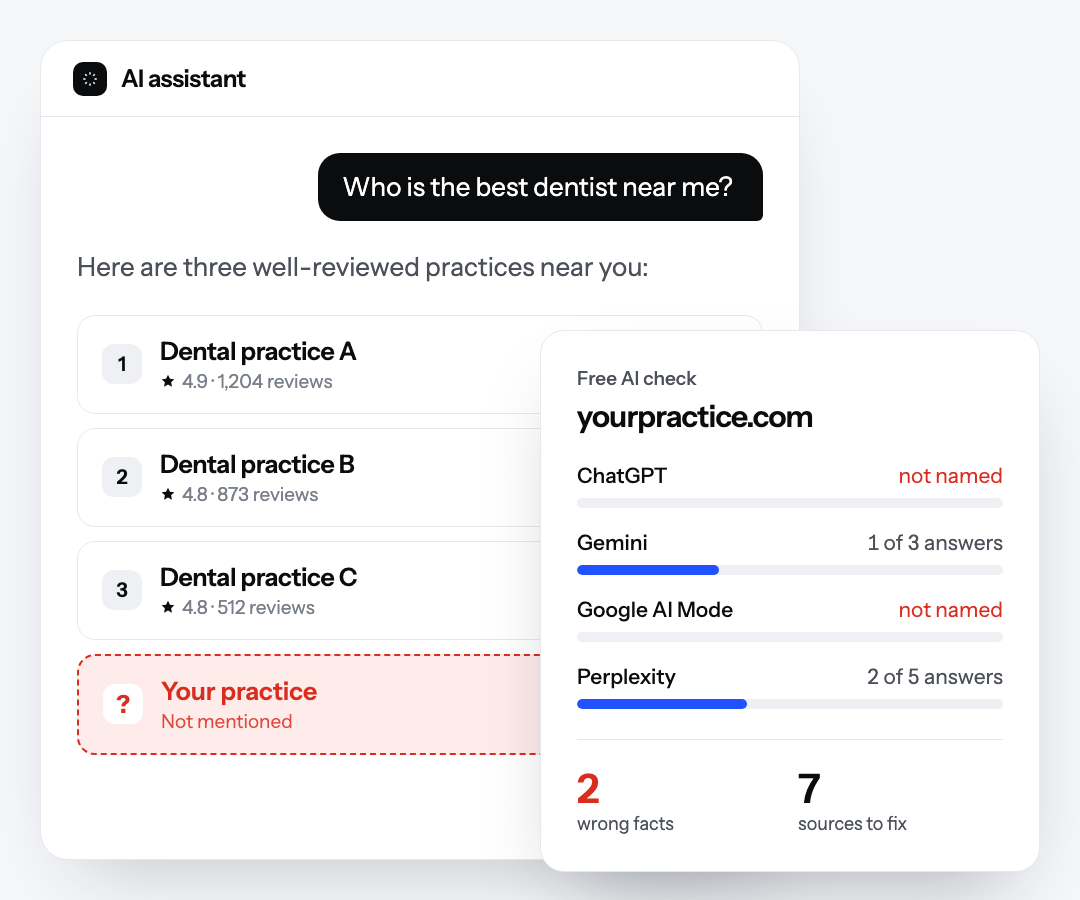
The free audit runs both checks for you: the category question three times in ChatGPT, twice in Gemini and once in Google AI Mode, plus the by-name question.
Step 2: Fix your Google Business Profile
Your Google profile is the most important single source. In the UK and EU, every ChatGPT card we checked showed exactly the rating and review count from the business’s Google profile, 12 of 12 businesses in seven countries. Gemini answered local questions mostly out of Google Maps, linking to maps.google.com in 60 of 87 answers. So one profile feeds several engines.
- One profile per location. Duplicates split your reviews. In our first round, the only two cards that didn’t match Google were businesses with two profiles each.
- The right primary category and every service you offer.
- True hours, including holidays and emergency availability.
- Your website link pointing to the right page. In our checks, the website link on ChatGPT cards often carried Google’s tracking tags, it was taken from the profile.
- Real photos and a description that says who you serve and where.
Do the same for Bing Places and Apple Business Connect. They take an hour and remove contradictions.
Step 3: US only, your Yelp page
If you are in the US, your Yelp page may be what ChatGPT shows. Yelp announced a licence for its reviews, ratings, photos and business data in ChatGPT on 23 July 2026 (Yahoo Finance, Jul 2026). In our check, 159 of 341 US ChatGPT cards carried Yelp’s logo and Yelp’s numbers. In Denver, all ten dental cards we checked showed the Yelp rating: 3.9 stars on average, against 4.75 on Google for the same practices.
- Claim your Yelp page for free and correct name, address, phone, hours, categories and website.
- Reply to reviews publicly and calmly.
- Don’t ask customers for Yelp reviews specifically, Yelp’s rules forbid it. A “Find us on Yelp” link is fine.
The card type can change from one answer to the next for the same business. Keep both Google and Yelp in good shape. Outside the US we saw no Yelp cards at all.
Step 4: The directories ChatGPT searches
ChatGPT searches review sites and directories, and they differ by industry and country. These are the ones engines cited or searched in our checks:
| Industry | Where AI looked (seen in our check) |
|---|---|
| Dentists, US | ADA Find-a-Dentist, Zocdoc, Healthgrades, Birdeye, WebMD |
| Dentists, Europe | CQC and GDC register (UK), Doctolib (France), Doctoralia (Spain), MioDottore (Italy), ZnanyLekarz (Poland), Herold (Austria) |
| Lawyers, US | Avvo, Justia, Super Lawyers, Expertise.com, bar associations |
| Med spas, US | RealSelf, online booking pages, clinic price pages |
| Roofing, HVAC, plumbing, US | Angi, HomeAdvisor, BBB, Expertise.com, the GAF contractor directory |
| Trades, UK | Checkatrade, MyBuilder, Yell, MyJobQuote |
| Movers, US | The FMCSA register, ConsumerAffairs, moveBuddha |
In the UK, an independent test found Checkatrade in 78 of 80 ChatGPT answers about local trades and MyBuilder in 70 of 80 (Murray Digital, Aug 2026; small sample). If your industry has a register or licence lookup, make sure you appear there correctly too: ChatGPT checked those signals on its own.
See which directories AI cites for your industry and country, and whether you’re on them.
Step 5: Make your facts agree everywhere
When your sources disagree, ChatGPT picks one version, and your customer sees that one. Of the 21 businesses we checked by name, 12 had a website, Google profile or booking system that contradicted each other: different hours on the site and the profile, three addresses in three places, a tracking phone number in an old directory. The businesses with clean answers were the ones whose website and Google profile said the same thing.
Make a one-page fact sheet, legal name, address, phone, hours, services, price ranges, languages, licence numbers, and check it against your website, Google profile, Bing, Apple, Yelp (US) and each directory from step 4. Fix the source, not the AI answer: there is no form to correct ChatGPT directly.
Step 6: Pages ChatGPT can quote
AI engines rarely know what you charge. Courtyard found AI engines scored 0.04 out of 1 on understanding dental practices’ prices, against 0.83 on services (Courtyard, Jul 2026; Courtyard sells AI visibility software). In our check, only 1 of 72 continental-EU category answers mentioned a price at all, and when engines were asked about a business by name, prices were where most errors were. Publish your own, or AI may use someone else’s.
- One page per main service, with the answer in the first lines: who it’s for, what happens, price range (with the date checked), payment options.
- Area, hours, languages, credentials stated in plain text, not only in images or behind a booking widget.
- Let AI crawlers in. Check that your robots.txt and firewall don’t block OAI-SearchBot, which OpenAI uses to show websites in ChatGPT’s search features (OpenAI, checked 3 Oct 2026).
You don’t need an llms.txt file or special “AI schema”. Google says optimizing for generative AI search “is optimizing for the search experience, and thus still SEO” (Google Search Central, 2026), and a study of about 300,000 domains found no link between llms.txt and AI citations (SE Ranking, Nov 2025).
Step 7: Reviews, the way
Reviews do double duty: they feed the cards, and people check them. 97% of people who use AI to find local businesses sometimes check its recommendation against real reviews (BrightLocal, 2026).
- Ask every customer after the job, by the same simple method, no filtering out unhappy ones, no discounts for reviews.
- Reply to reviews, especially critical ones. In healthcare, never confirm that a reviewer is your patient.
- Never buy reviews. It breaks platform rules and consumer law, and AI engines and customers both look at review patterns.
Mentions help too. Across 75,000 brands, web mentions correlated with AI visibility more strongly than backlinks did (Ahrefs, Dec 2025; correlation, not proof of cause). For a local business that means local press, partner pages and associations that name you.
Step 8: Measure in k of n
After 60 and 90 days, repeat step 1 exactly: same questions, same wording, five runs in ChatGPT, and the same in any other engine you track. Compare “named in 1 of 5” with “named in 3 of 5”, not one screenshot with another. Check other engines separately, the lists ChatGPT and Gemini gave us overlapped very little, and in Denver not a single plumber appeared on both. Why there is no fixed “rank” in ChatGPT explains the measurement side in more detail, and our methodology shows how we count.
Why your business isn’t on ChatGPT
If ChatGPT never names you, the cause is usually one of these:
| What you see | Likely cause | Where to look |
|---|---|---|
| Named sometimes, not in the answer you saw | Normal run-to-run variation | Ask five times and count |
| Never named; competitors with more reviews are | Thin profile, few reviews, missing from directories | Steps 2, 4 and 7 |
| Card shows a low rating you don’t recognize (US) | The card shows your Yelp numbers | Step 3 |
| Wrong hours, address or phone in the answer | Your own sources disagree, or an old listing | Step 5 |
| No card when asked by name | Website down or mismatched with your profile | Steps 2 and 6 |
| Named in English but not in your local language (or the reverse) | The language of the question changes the list | State languages on site and profile |
On the last point: in Vienna, ChatGPT’s answers to the same dentist question in German and in English shared only 3 of 21 practices. Practices that said which languages they speak were the ones named for “English-speaking dentist”.
Wondering whether you can pay to appear? Read ChatGPT ads vs. getting recommended organically. If you’d rather have someone do steps 1–8 for you, that is our ChatGPT optimization service, every profile stays in your name.
FAQ
How do I get ChatGPT to recommend my business?
Make the sources ChatGPT reads complete and consistent: your Google Business Profile, your Yelp page in the US, the review sites and directories for your industry, and a website that states your services, prices, area and hours in plain text. Then check how often you are named over several runs, not once.
Does ChatGPT use Google reviews?
Outside the US, yes in every case we checked. In our check on 3 Oct 2026, ChatGPT’s business cards in seven UK and EU countries matched the Google profile exactly for all 12 businesses we compared. In the US the card may show Google or Yelp numbers.
Does ChatGPT use Yelp reviews?
In the US, often. Yelp announced a licence for its reviews, ratings, photos and business data in ChatGPT on 23 July 2026. In our check, 159 of 341 US ChatGPT cards carried Yelp’s logo and Yelp’s numbers. We saw no Yelp cards in the UK or EU.
Why is my business not on ChatGPT?
Usually one of four things: ChatGPT named you in some runs but not the one you saw; your Google profile or directory listings are thin or contradict each other; the review sites ChatGPT searches don’t list you; or your website blocks AI crawlers or hides key facts. A single missing answer is not proof you are absent.
Can I pay ChatGPT to recommend my business?
Not as an organic recommendation. OpenAI does run ads on ChatGPT, but an ad is a labelled placement, not a place in the answer itself. Our guide on ChatGPT ads vs. organic recommendations lays out what is publicly known and what we could not confirm.
How long does it take before ChatGPT names my business?
Nobody can promise a date. Profile and listing fixes are usually live within days to weeks; how quickly they change AI answers varies by engine and market. Measure before you start and again after 60 and 90 days, with the same questions and the same number of runs.