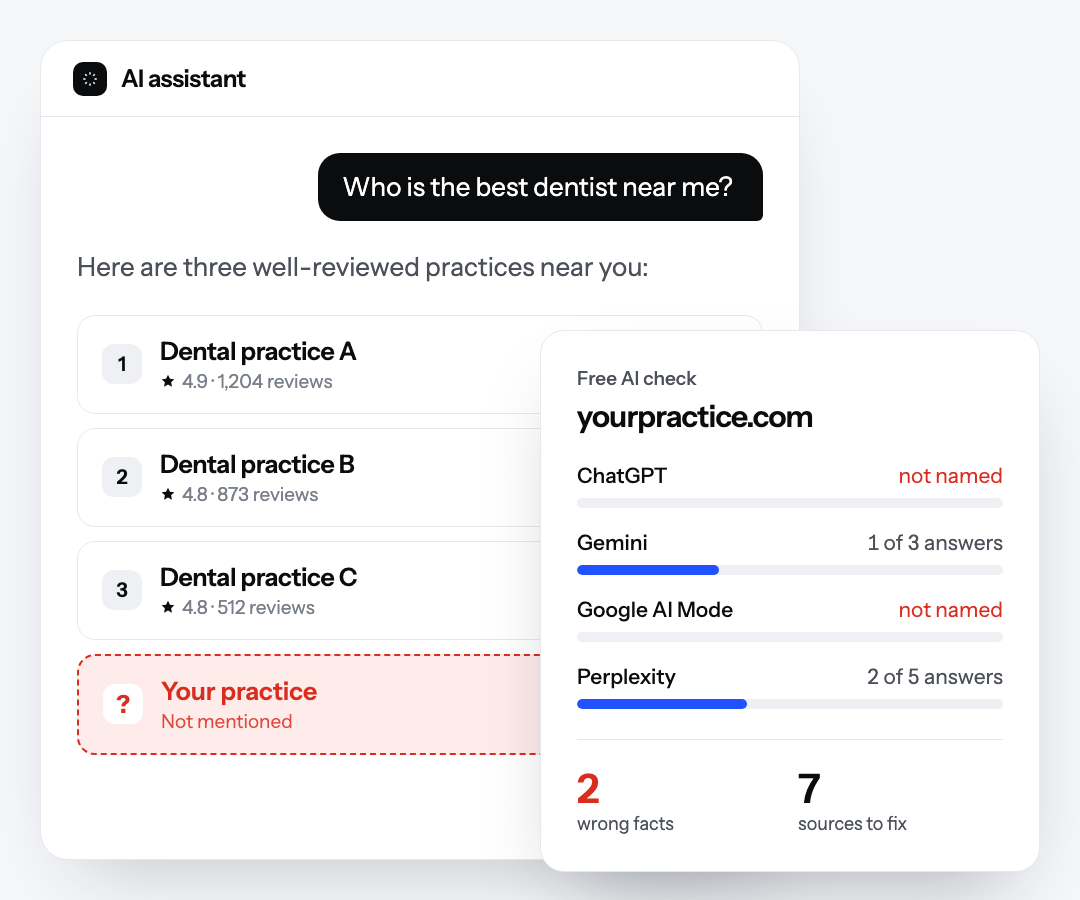
Does SEO still cover AI visibility?
Mostly yes, and you should not throw away good SEO. Google’s own guidance, published in May 2026 and updated in July, says that “optimizing for generative AI search is optimizing for the search experience, and thus still SEO”, and that llms.txt files, content chunking and special schema are not needed (Google Search Central).
But good rankings alone don’t predict whether AI names you:
- AI Overviews cite well beyond the top ten. Ahrefs found that 37.9% of AI Overview citations came from top-10 organic results, and 31% from pages outside the top 100 (Ahrefs, Mar 2026; the method changed from their 2025 study).
- For local businesses, Maps rank doesn’t carry over either. A business in 66% of Google Maps results appeared in only 33% of ChatGPT answers and 32% of AI Mode answers (BrightLocal, Sep 2026).
So AI SEO is not a new discipline. It is SEO with three gaps closed.
What changes vs classic SEO
Most of classic SEO stays; a few things change; a few popular “AI” tactics can be dropped. Each row links to its source.
| Keep / change / drop | What | Why |
|---|---|---|
| Keep | Crawlable, fast pages that answer real questions | Google: optimizing for generative AI search “is still SEO”. Google, 2026 |
| Keep | Local SEO: Google profile, reviews, citations | Google Business Profiles are 28.63% of citations in US local AI answers; websites 42%. BrightLocal, Sep 2026 |
| Change | Maintain the sources beyond your site | Yelp is 9.53% of local AI citations; in our US check, about half of ChatGPT’s business cards showed Yelp’s numbers. BrightLocal, Sep 2026; our check |
| Change | Earn mentions, not just links | Brand mentions correlate with AI visibility more than links or content volume (web mentions 0.66–0.71, content volume about 0.19). Correlation, not proof of cause. Ahrefs, Dec 2025 |
| Change | State facts plainly: prices, area, credentials, hours | Engines quote what they can find. In our checks, missing prices were filled with other businesses’ prices. our check, 3 Oct 2026 |
| Change | Measure answers, not just rankings | Asked again, engines repeat only 20–33% of the businesses they named. BrightLocal, Sep 2026 |
| Drop | llms.txt as a lever | No correlation with being cited, across ~300,000 domains. SE Ranking, Nov 2025 |
| Drop | Special “AI schema”, content chunking, FAQ markup for rich results | Google says they aren’t needed; FAQ rich results stopped showing on 7 May 2026. Google, 2026 |
| Drop | Mass AI-written content | Of 220+ publicized AI-content “success stories”, 54% later lost at least 30% of peak traffic (a biased sample of promoted cases). Lily Ray, May 2026 |
If you want the detail on the “drop” rows, our AEO page goes through what you don’t need to pay for. Google also calls it “critical” to fact-check AI-generated content by hand before publishing (Google, Oct 2026), guidance rather than a new rule, and how we work anyway.
The technical layer AI depends on
AI assistants can only repeat what they can fetch and read. These are the checks our audit runs first; each one has a clear pass or fail.
AI crawler access
robots.txt is only half the check. The other half is what your server, CDN or firewall returns. A site can allow a crawler in robots.txt and still send it a challenge page or a 403. We request your key pages as each of these crawlers and record the real response:
GPTBot, robots.txt rule · HTTP status · blocked by firewall?OAI-SearchBot, robots.txt rule · HTTP status · blocked by firewall?ClaudeBot, robots.txt rule · HTTP status · blocked by firewall?PerplexityBot, robots.txt rule · HTTP status · blocked by firewall?Google-Extended, robots.txt rule · HTTP status · blocked by firewall?
Readable without JavaScript
Prices, services, address and opening hours should be in the HTML the server sends, not loaded later by a script or hidden behind a form. If a page only shows prices after JavaScript runs, some crawlers will never see them, and engines will fill the gap from elsewhere. In our by-name checks, engines quoted old pre-discount prices and even another practice’s prices when the business’s own price wasn’t readable.
Entity data: one name, one address, one phone
Your Organization or LocalBusiness markup should validate and match your legal and Google-profile name. Name, address and phone should be identical on the site, the Google profile and the directories. In our checks, one engine found a look-alike website with a different phone number and called it the business’s own; others repeated an old address still listed in directories.
Your Google profile is part of your SEO now
On 3 October 2026, ChatGPT’s business cards in the UK and EU showed exactly the rating and review count from the Google profile, 12 of 12 businesses we checked by name in seven countries. In our first round, 20 of 186 website links in ChatGPT cards still carried Google-profile tracking tags: the link was taken from the profile. In the US, about half the cards (159 of 341) showed Yelp’s numbers instead. A duplicate or stale profile is an AI SEO problem: in our first round, the only two cards that didn’t match Google belonged to businesses with two profiles.
- Your website42% of US local AI citations
- Google Business Profile28.63% of citations; source of UK/EU ChatGPT cards
- Yelp and directoriesYelp 9.53% of citations; about half of US ChatGPT cards
- The AI answerA short list with cards: name, rating, reviews, link
Citation shares: BrightLocal, US, Sep 2026. Card sources: our check, 3 Oct 2026, small sample.
Run the crawler-access and profile check on your site.
Measuring AI SEO without fooling yourself
Measure AI SEO by asking the same questions several times in the apps people use, and count how often you’re named. Rankings won’t tell you, and neither will one screenshot.
Be careful with tools that query an AI model’s developer API instead of the app. In our check, of 24 businesses the ChatGPT API named, only 6 appeared in five runs of the ChatGPT app. A tracker built on the API can show you a different ChatGPT from the one your customers see.
We read the answers from the apps, repeat each question (ChatGPT five times, Gemini three, AI Mode once or twice), and report “named in k of n” with dates. The full method is on our methodology page, and the measurement plan for a whole engagement is part of our GEO programme. Bing Webmaster Tools also shows first-party data on how often Bing’s AI answers cite your pages, worth connecting. Our samples are small and from one day; the data is on our research page.
Two ways to work with us
You can have us do the work, or keep it in-house and use us as consultants. Both start with the same audit.
| Done for you | Consultant | |
|---|---|---|
| Best for | No one in-house to make changes | You have a developer, marketer or SEO person |
| Scope | Deep audit → implementation blocks → monthly maintenance | Deep audit + prioritized plan + two 60-minute calls with your team |
| Who implements | We do, in your accounts | Your team; we review |
| Re-measurement | After 60 and 90 days, then monthly | Optional after 60 or 90 days |
| Price | Foundation from $3,000 (€2,400); Maintain from $790 (€590) a month | Deep audit $1,200–1,900 (€890–1,490) plus two calls, ask for a quote |
Either way, every profile and account stays in your name, and there is no minimum term. The profile and directory side is covered in depth on our local AI search page.
What AI SEO costs
With us, AI SEO starts with a free audit and has fixed prices after that: a deep audit at $1,200–1,900 (€890–1,490), Foundation implementation at $3,000–4,500 (€2,400–3,200), and Maintain at $790–1,290 (€590–990) a month, excluding VAT. For context, US agencies quote $1,500–5,000 a month for small-business GEO (WebFX, May 2026, agency figures), and an older Ahrefs survey put the average SEO agency retainer at $3,209 a month (Ahrefs; older data, before 2025). See full pricing.
Some people search for “LLM SEO”. It’s the same work: making large language models, the engines behind ChatGPT, Gemini and Perplexity, find, read and repeat correct facts about you.
FAQ
Is SEO still relevant for generative AI search?
Yes. Google says optimizing for generative AI search is still SEO. For local businesses, AI answers also lean on sources outside your site, your Google profile, Yelp in the US, industry directories and reviews, which many SEO retainers don’t maintain.
What are the ranking factors for AI search?
No published list exists. For local answers, the inputs you can see are your website, Google profile, Yelp and directories, how consistent the facts are across them, and your reviews. Brand mentions correlate with AI visibility (Ahrefs), a correlation, not a proven cause.
Do you work with small businesses?
Yes. Single- and few-location businesses are our core: clinics, trades, realtors, law firms, movers. Packages are fixed in scope and price, and there is a consultant option if you have someone in-house.
AI SEO consultant or agency: which do I need?
A consultant if someone on your side, a developer or marketer, can implement. An agency if nobody can. The audit is the same either way, and you can stop after it.
How do I do SEO for AI search myself?
Unblock AI crawlers at the server and firewall, not only in robots.txt. Put prices, services and address in plain HTML. Make your Google profile and directory listings match your site. Collect reviews. Then measure by asking the same questions several times.
How much do AI SEO services cost?
With us, a deep audit is $1,200–1,900 (€890–1,490), implementation starts at $3,000 (€2,400) and maintenance at $790 (€590) a month. See the pricing page for the full ladder.