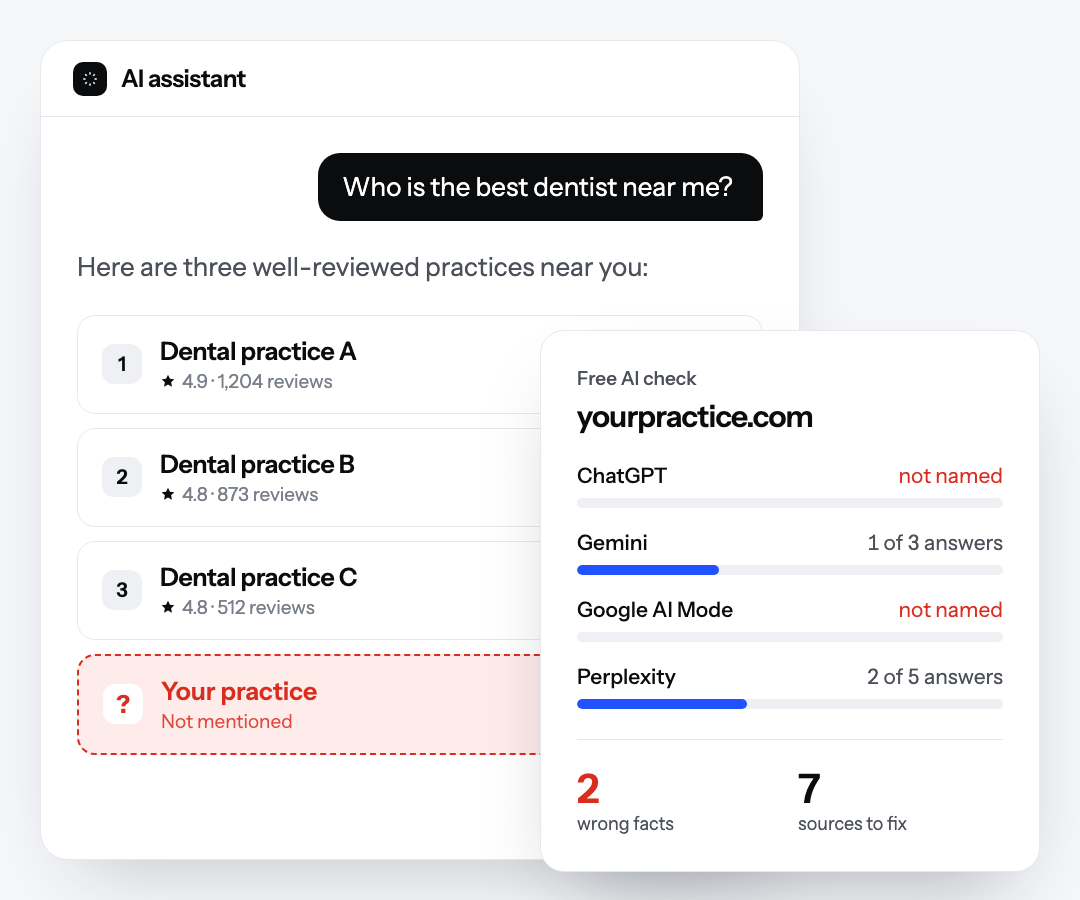
Is there a ranking in ChatGPT?
No, not a stable one. Google keeps a ranked list of pages for each search, and it changes slowly. ChatGPT writes a new answer each time. For “who should I use in [city]” questions it runs a search, reads a handful of sources and names a few businesses. Ask again and some names change.
On 3 October 2026 we asked ChatGPT 29 local questions across 10 countries, five times each. Small samples, one day, but the picture was clear:
- In our first round, ChatGPT named 90 businesses across five runs of eight questions. 44 of them appeared in only one of the five runs. Just 25 were named in three or more.
- Across all three rounds, 119 of 297 businesses appeared in only one run of five. Stability varied by market: lists for US lawyers and movers were steadier, dense markets like dentists in big cities moved more.
- A first answer is a poor guide. Of the businesses named in a first run, only 21 of 37 belonged to the group ChatGPT named in at least three of five runs.
So when someone sells a “#1 position in ChatGPT” or sends you a single screenshot as proof, treat it as an anecdote. It may not be there on the next try.
Why the list changes every time
Three things move the answer between runs:
- The search behind the answer. ChatGPT typically ran one search like “dentist Austin reviews 2026” and read what came back. Small differences in what it reads produce different names.
- Generation itself varies. Even from the same sources, a language model doesn’t write the same answer twice.
- The card data. In the US, the same business sometimes appeared with Google’s numbers and sometimes with Yelp’s, in different runs.
Here is one question, “Can you recommend a good dentist in Austin, TX?”, asked five times in ChatGPT, three times in Gemini and once in Google AI Mode on the same day. ChatGPT named 14 different practices; one practice appeared in all five runs.
Question:“Can you recommend a good dentist in Austin, TX?”
| Practice | ChatGPT5 runs | Gemini3 runs | Google AI Mode1 run | Google Maps (top results)1 run |
|---|---|---|---|---|
| Practice A | ||||
| Practice B | ||||
| Practice D | ||||
| Practice C | ||||
| Practice H | ||||
| Practice I | ||||
| Practice E | ||||
| Practice F | ||||
| Practice G | ||||
| Practice J | ||||
| Practice K | ||||
| Practice L | ||||
| Practice M | ||||
| Practice N | ||||
| Practice O | ||||
| Practice P | ||||
| Practice Q | ||||
| Practice R |
The useful reading of this chart: Practice A is reliably named, a few are often named, and many show up once. That is the shape of “visibility” in ChatGPT, a frequency, not a position.
What to measure instead of a rank
Measure how often you are named, as a fraction with a date: “named in 3 of 5 answers, 3 October”. Three rules make the number mean something:
- Fixed questions. Write down the exact wording customers use, including the city. Don’t change it between measurements.
- Enough runs. At least three, preferably five per question. In our first round, going from three to five runs grew the list from 67 to 90 businesses.
- No percentages from a few runs. “1 of 3” is honest; “33% AI visibility” suggests a precision that isn’t there.
Watch who is named instead of you, too. If the same two competitors appear in four or five of five runs, look at what their profiles and listings have that yours lack. Our methodology describes how we count runs and engines.
What makes ChatGPT name you more often
OpenAI publishes no ranking factors for this. What we can see is which sources ChatGPT reads and which businesses keep appearing. The businesses named most consistently in our checks shared these traits:
| Factor | What we saw |
|---|---|
| A strong, accurate Google profile | In the UK and EU, every ChatGPT card we checked matched the Google profile exactly (12 of 12 businesses). In markets with one clear leader with a strong Google profile, that business was usually named in 4 or 5 of 5 runs; in crowded markets the top name kept changing. |
| Your Yelp page (US only) | 159 of 341 US ChatGPT cards showed Yelp’s logo and numbers. A weak Yelp page can be what customers see. |
| Presence on the review sites ChatGPT searches | ChatGPT cited about 1.8 sources per answer, mostly directories and review sites, Avvo for lawyers, Checkatrade in UK trades, ADA Find-a-Dentist and Zocdoc for US dentists. |
| Industry trust signals | Its searches added words like “licensed FMCSA” (movers), “bar association” (lawyers), GAF and BBB (roofers), CQC (UK dentists). Being findable in those registers matters. |
| Consistent facts | Businesses whose website and Google profile agreed got correct answers about hours, address and prices. 12 of the 21 businesses we checked by name had sources that contradicted each other. |
| Clear pages in your language | A clearly stated service, area and language helped: in Vienna, the German and English dentist questions shared only 3 of 21 practices, and the English list favored practices that said they speak English. |
| Mentions beyond your site | Across 75,000 brands, web mentions correlated with AI visibility more than backlinks did (Ahrefs, Dec 2025; correlation only). |
Classic Google rankings help but don’t transfer automatically: a business in 66% of Google Maps results for its searches appeared in only 33% of ChatGPT answers (BrightLocal, Sep 2026). The step-by-step version of this table is in how to get ChatGPT to recommend your business.
Get your baseline: we ask ChatGPT three times, Gemini twice and AI Mode once, and show who’s named instead.
What doesn’t move it
- llms.txt. A study of about 300,000 domains found no correlation between having one and being cited by AI (SE Ranking, Nov 2025).
- Special “AI schema” or content chunking. Google says optimizing for generative AI search “is optimizing for the search experience, and thus still SEO”, and that these extras aren’t needed (Google Search Central, 2026).
- Publishing lots of AI-written posts. Of 220+ publicly promoted AI-content “success stories”, 54% later lost at least 30% of their peak traffic (Lily Ray, May 2026; a self-selected sample).
- Bought or filtered reviews. They break platform rules and consumer law, and 97% of AI users sometimes check AI recommendations against real reviews (BrightLocal, 2026).
- Telling ChatGPT about yourself in a chat. Your conversation doesn’t change what other people’s answers draw on.
How to check it yourself, properly
A careful manual check takes about 20 minutes:
- Write two questions a customer would ask, with your city: “Can you recommend a good [service] in [city]?” and one with intent, like “…open on Saturdays” or “…that speaks Spanish”.
- Ask each question five times, each in a new chat, ideally logged out or in a temporary chat so memory doesn’t steer the answer.
- Write down every business named, in a simple table: business × run. Note whether a card appeared and, in the US, whether it carried Yelp’s logo.
- Count “k of 5” for you and for each competitor.
- Ask about yourself by name: hours, address, phone, prices. Compare with your website and Google profile.
- Save the date and the wording. Repeat the same check after 60 and 90 days.
Limits of a manual check: answers for logged-in users, paid plans, your own location or chat history can differ. Be careful with tools that read the developer API instead of the app, in our check, of 24 businesses the API named, only 6 appeared in five runs of the ChatGPT app for the same questions.
ChatGPT is not the only list
Customers also ask Gemini and Google AI Mode, and those engines give different lists. The businesses named by ChatGPT and by Gemini for the same question overlapped very little in our checks, a Jaccard similarity of 0.17 to 0.22 depending on the round. For Denver plumbers and Houston immigration lawyers, not a single business was on both lists. Gemini mostly followed Google Maps; Google’s map top three appeared in Gemini’s lists far more often than in ChatGPT’s.
Check each engine separately, with the same questions. Google’s AI Overviews rarely appear for local questions, on 3 of 29 searches in our check, so for Google, watch AI Mode and the map results. Full numbers are in our research.
If you’d rather not run this yourself every month, our ChatGPT SEO service fixes the sources and measures in k of n. Curious whether you can pay your way in instead? See ChatGPT ads vs. organic recommendations.
FAQ
How do I rank higher in ChatGPT?
There is no fixed position to climb. What you can raise is how often ChatGPT names you across repeated answers. That depends mostly on the sources it reads: your Google profile, Yelp in the US, the review sites and directories in your industry, consistent facts and reviews.
Is there a ChatGPT ranking I can check?
No stable one. ChatGPT named about four or five businesses per answer in our checks, and the list changed between runs. In our first round, 44 of the 90 businesses it named appeared in only one of five runs. Count how often you are named, for example “3 of 5”.
Does ChatGPT search use Google or Bing rankings?
Not in a way you can read off a rank. For local questions ChatGPT searched review sites and showed cards whose numbers matched Google profiles or, in the US, often Yelp. Ranking well on Google helps but doesn’t carry over automatically: a business found in 66% of Google Maps results appeared in 33% of ChatGPT answers in BrightLocal’s study.
Why does ChatGPT recommend my competitor and not me?
Often because the competitor has a fuller Google profile, more reviews on the sites ChatGPT searches, or listings in the industry directories it checks. Sometimes it is just variation: ask five times before drawing conclusions. Compare the sources, not the answer.
Do AI rank trackers show what customers see?
Not always. Many trackers query ChatGPT through the developer API. In our check, of 24 businesses the API named, only 6 appeared in five runs of the ChatGPT app for the same questions. Ask which interface a tracker reads and how many runs it uses.
How many times should I ask ChatGPT to check my visibility?
At least three, better five, each in a new chat, same wording. In our first round, going from three to five runs grew the list of named businesses from 67 to 90. Record the result as a fraction with the date.